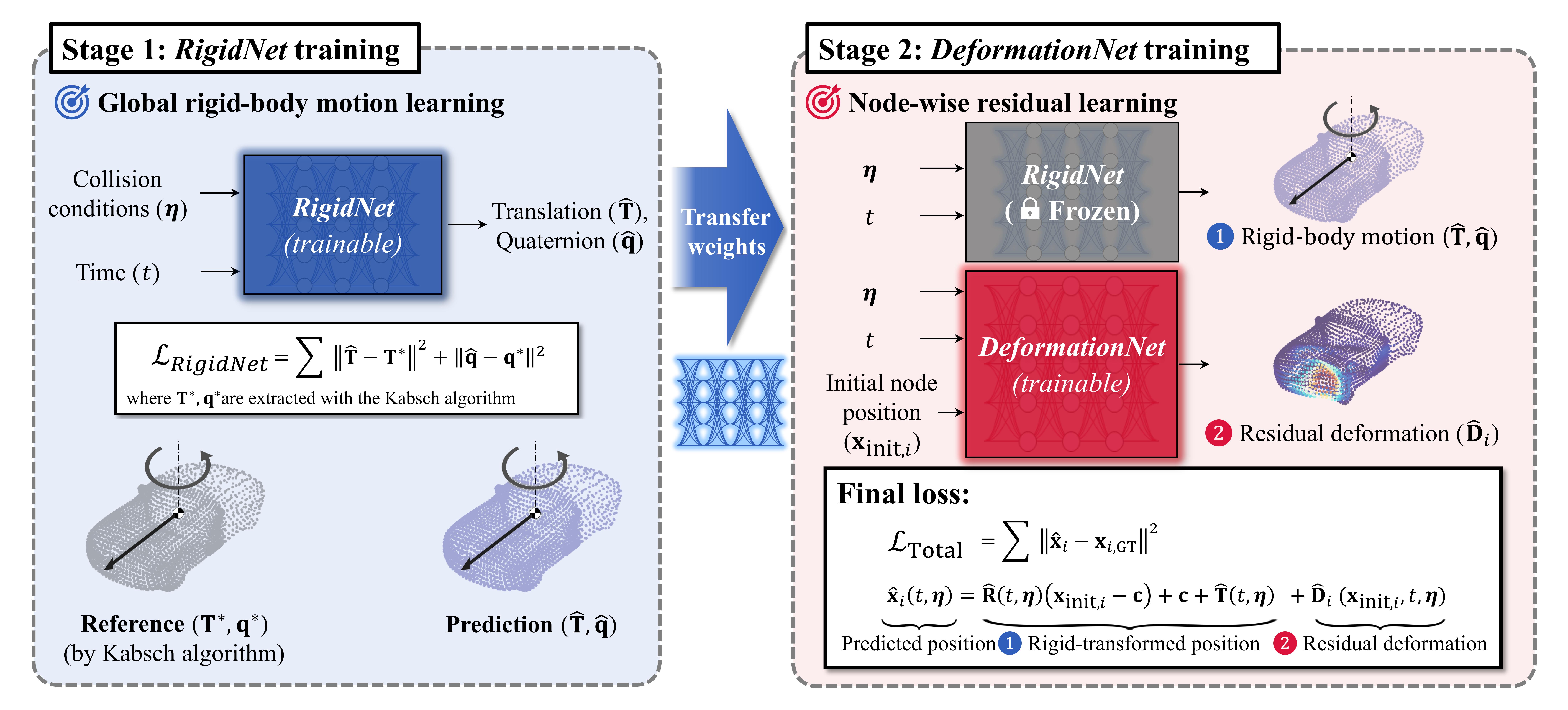
A hierarchical deep learning framework that decouples global rigid-body motion from local structural deformation, enabling real-time 3D spatio-temporal prediction of full-scale vehicle crash dynamics.
Select a collision scenario and watch the framework predict the full 3D crash dynamics in real time.
RigidNet captures low-frequency global motion; DeformationNet resolves high-frequency structural buckling — addressing the spectral bias that causes single-network architectures to smooth over critical failure modes.
A sequential training strategy freezes RigidNet as a kinematic anchor, yielding 17.2% lower total error than the best unified baseline and 29.8% lower rigid-body error than joint training.
Recovers 92% directional correlation and 96% deformation localization accuracy vs. oracle, with 1.8% peak frontal intrusion error.
Collision behavior consists of two coupled components: rigid-body motion, which governs post-crash vehicle trajectory and secondary accident risk, and structural deformation, which captures crush, intrusion, and occupant safety-related damage. Standard single networks cannot separate these entangled scales.
Low-frequency translation and rotation driven by inertia. Smooth trajectory over the full 0.4 s collision.
High-frequency buckling and plastic hinging in the frontal region. Transient peaks within milliseconds of impact.
Standard neural networks exhibit spectral bias toward low-frequency components, plateauing at ~2.0×10⁻³ MSE regardless of architecture. Our decomposition breaks through this ceiling.
| Model | Architecture | Val MSE (×10-3) |
|---|---|---|
| DeepONet | Unified (Operator) | 3.22 |
| Coupled MLP | Unified (MLP) | 2.04 |
| Transolver | Unified (Transformer) | 1.92 ± 0.07 |
| Proposed (Ours) | Decomposed | 1.69 ± 0.02 |
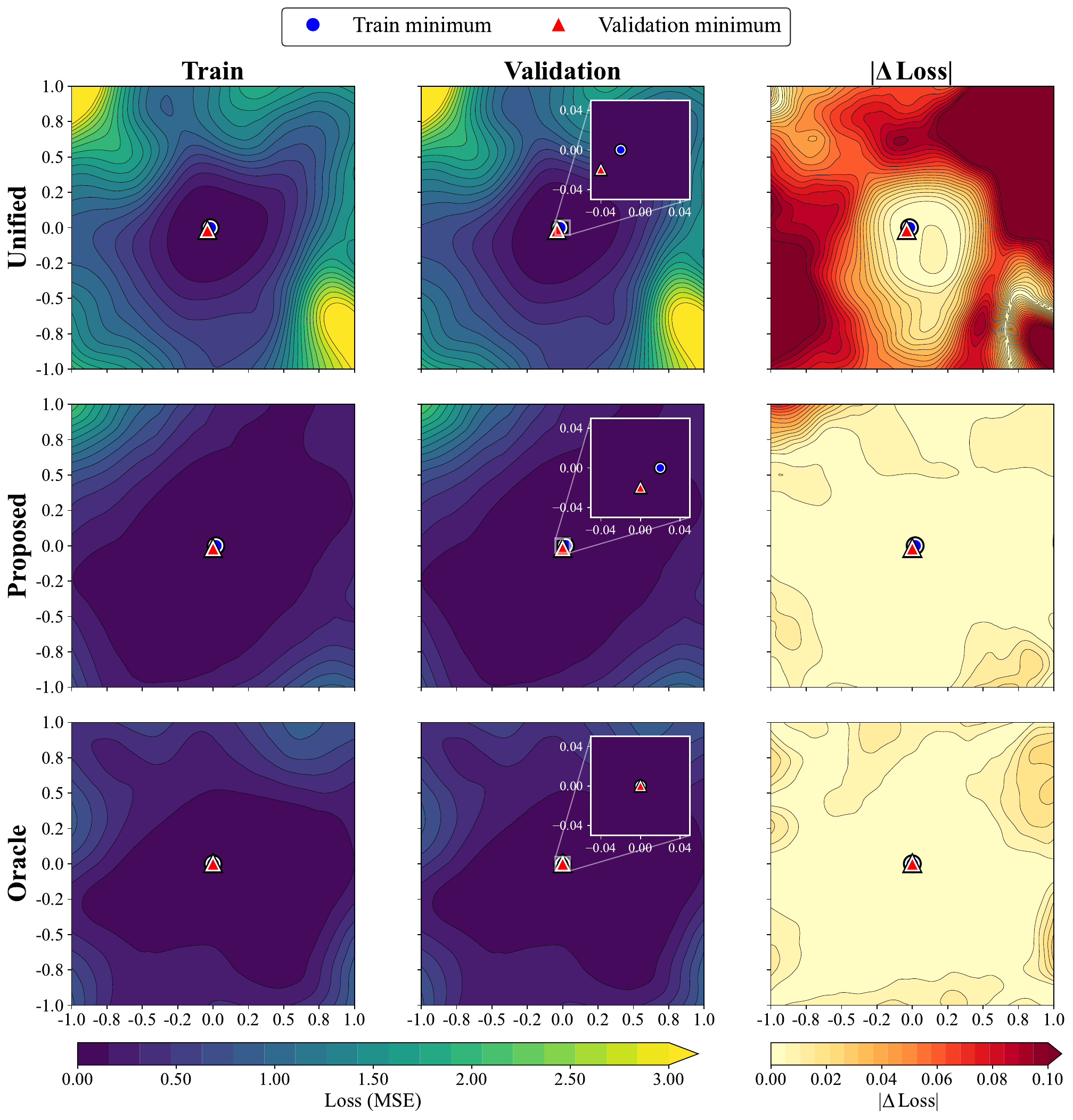
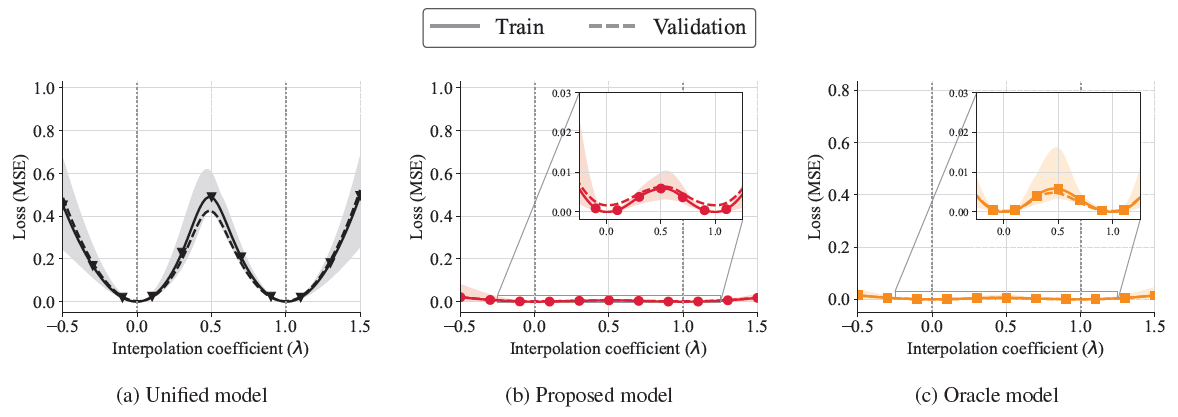
Decomposition transforms the loss surface from sharp, isolated minima into a broad flat basin.